
FNSC4180 |
 Food Factory Field Trip Old Picture |
Showing posts with label Review Session. Show all posts
Showing posts with label Review Session. Show all posts
Tuesday, April 24, 2018
Explaining the bacterial injury experiment once again
The bacterial injury experiment was explained again. To understand the experiment better, you can read the question A2 of past paper 201617 together with the curve in the notes.

About salt tolerance
Q: On the web, we can find that salt tolerance limit of Clostridium perfringens is 6%, different from the 10% we used in the notes. How to judge?
A: You can always find different limits for the parameters of a microbe. There are many factors affecting the reporting of the limits. The better way to deal with this is to use the least stringent one to assume the growth or survival of the microbe. For example, if you find 6-10% as the salt content limit for C. perfringens, take it that it can grow at 10% salt. You will have a good margin to be safe.
In the real world, you will need to do the experiment to determine the limits for your own target food and microbe.
The main effect of adding salt is to lower water activities. Low water activities will never kill all the microbes.
A: You can always find different limits for the parameters of a microbe. There are many factors affecting the reporting of the limits. The better way to deal with this is to use the least stringent one to assume the growth or survival of the microbe. For example, if you find 6-10% as the salt content limit for C. perfringens, take it that it can grow at 10% salt. You will have a good margin to be safe.
In the real world, you will need to do the experiment to determine the limits for your own target food and microbe.
The main effect of adding salt is to lower water activities. Low water activities will never kill all the microbes.
Past paper 201617
Q. B3e. How to calculate?
A: Target set: 900/ml to 1/ml. Reduction is ~1000-fold. You have the D value of the temperature 98C and the time of 21 sec. Is the combination giving 1000-fold reduction or more? If yes, then the industrial standard is sufficient.
A: Target set: 900/ml to 1/ml. Reduction is ~1000-fold. You have the D value of the temperature 98C and the time of 21 sec. Is the combination giving 1000-fold reduction or more? If yes, then the industrial standard is sufficient.
Past paper 201415
Q: B4e. How to do it? "The canning temperature can be raised 15°C without any adverse effect on the quality of the canned hams. Hence, the technician would like to use l20°C in the canning process to treat this lot of contaminated ham. Calculate the treatment time required at 120°C to achieve (i) the acceptable cell density for this contaminated lot and (ii) the acceptable cell densities of the microorganisms of the regular lot of ham after canning with this new process. Justify your answer and explain. (10 marks)"
A: Use the Z value to calculate the new D value at 120C. Use this new D value to calculate your treatment timed for the targeted reductions for bacteria and for spores. You need to calculate twice, one for the contaminated lot and one for the regular lot to complete your answer.
A: Use the Z value to calculate the new D value at 120C. Use this new D value to calculate your treatment timed for the targeted reductions for bacteria and for spores. You need to calculate twice, one for the contaminated lot and one for the regular lot to complete your answer.
Past paper 201617
Q: A3, How to judge whether the bacteria would be killed or could not grow under the condition?
A: You have to know the characteristics of the bacteria. The bacteria in this question are those with some distinct characteristics. You have to match their characteristics to the treatment or process to judge whether they can be killed or still be able to grow.
A: You have to know the characteristics of the bacteria. The bacteria in this question are those with some distinct characteristics. You have to match their characteristics to the treatment or process to judge whether they can be killed or still be able to grow.
Past examination paper 201617
Q: A3, which parameter would be the most important? what about the parameters not mentioned in the treatment or process?
A: Importance of parameter depends on the parameter itself and the target microbe, no strict rules. The parameters not mentioned may remain the same, but changing one thing may have multiple effects and change other parameter. for example, adding salt changes also the water activities, or removing oxygen would change also the Redox.
A: Importance of parameter depends on the parameter itself and the target microbe, no strict rules. The parameters not mentioned may remain the same, but changing one thing may have multiple effects and change other parameter. for example, adding salt changes also the water activities, or removing oxygen would change also the Redox.
Salt content limits
Q: salt content higher than the maximum limit, will the bacteria die?
A: salt content primarily affects water activities, bacteria would survive at low water activities.
A: salt content primarily affects water activities, bacteria would survive at low water activities.
Monday, April 23, 2018
why gram positive bacteria survive better than gram negative bacteria?
A: Depends on the type of challenges, if it is high temperature, spore formers of Gram positive bacteria can survive a lot better.
Review session: Nitrate inhibiting anaerobic bacteria growth?
A: Yes, nitrate is an oxidizing agent, raises Redox and inhibit anaerobic bacteria growth.
Thermal death time curve and F value?
A: F value is your target thermal death value, can be 2D, 3D, ................12D, any value depend on your target thermal reduction. You can draw the curve in many ways to get the temperature-time combination to reach your target. One example is given in the notes.
Past paper 201617 C
Q: A2. Recovery not back to log colonies number of 9.4/ml ? but only 8.5?
A: There was actual killing of the bacteria at 52C. Recovery can never go back to 9.4.
Q; a2 vi. c. botulinum killed by low level of oxygen?
A: yes.
A: There was actual killing of the bacteria at 52C. Recovery can never go back to 9.4.
Q; a2 vi. c. botulinum killed by low level of oxygen?
A: yes.
Past paper 201617 B
Q: B3 a., d ?
A: B3 a. No need. High acid food--low pH
B3 d. 3D reduction--900/1000 /ml = 0.9/ml. Temperature does not matter.
A: B3 a. No need. High acid food--low pH
B3 d. 3D reduction--900/1000 /ml = 0.9/ml. Temperature does not matter.
Past paper 201617 A--Please note the change in answers
Q: A3 iii, iv, ix
A: iii, G, S iv. NG.S. G, S. was a mistake ix. G. S.
Q: A4 Soy sauce chicken--bacteria? Bagel?
A.C. perfringens. should be none Bagel: Aspergillus
A: iii, G, S iv. NG.S. G, S. was a mistake ix. G. S.
Q: A4 Soy sauce chicken--bacteria? Bagel?
A.
Review question 1 201617 paper B4
Q: B4 f.
A: Find the odd one. It was No. 24 patient. Incubation period much longer than the other patients in the two outbreaks.
A: Find the odd one. It was No. 24 patient. Incubation period much longer than the other patients in the two outbreaks.
Thursday, April 19, 2018
Notes of Open Book Examination
Please note the following about Open Book Examination
1. You need to familiarize with the materials, you may not have enough time to search for everything. If you can answer without reading through your notes and books, answer right away, confirm later on. The time will always be tight.
2. Know the basic principles of outbreak analysis, thermo-treatment calculations, microbial growth, etc. You should know how to apply them.
3. Questions may not be always similar to previous years examinations.
4. Even if the questions looks similar to previous years, they may differ greatly in details. Don't answer yester-years' questions.
5. Pay attention to details.
I wish you acquire and use these skills and capabilities:
1. You need to familiarize with the materials, you may not have enough time to search for everything. If you can answer without reading through your notes and books, answer right away, confirm later on. The time will always be tight.
2. Know the basic principles of outbreak analysis, thermo-treatment calculations, microbial growth, etc. You should know how to apply them.
3. Questions may not be always similar to previous years examinations.
4. Even if the questions looks similar to previous years, they may differ greatly in details. Don't answer yester-years' questions.
5. Pay attention to details.
I wish you acquire and use these skills and capabilities:
- logical
- attention to details
- organized
- thorough
- careful in calculation
- familiarize--internalize knowledge
- read questions carefully
- good time management
- writing clearly and concisely
Open Book Examination
Dear Students,
The final examination of FNSC3180 Food Microbiology will be Open Book examination. Please check the final examination time table to make sure you know the date and time: 26 April 2018, 9:30am to 11:30am at Thomas H C Cheung Gymnasium, UC. Let me know if you have any questions.
Best,
HS Kwan
Monday, May 1, 2017
Review session 1, 2016-17. Reviewed questions Corrections

^
|
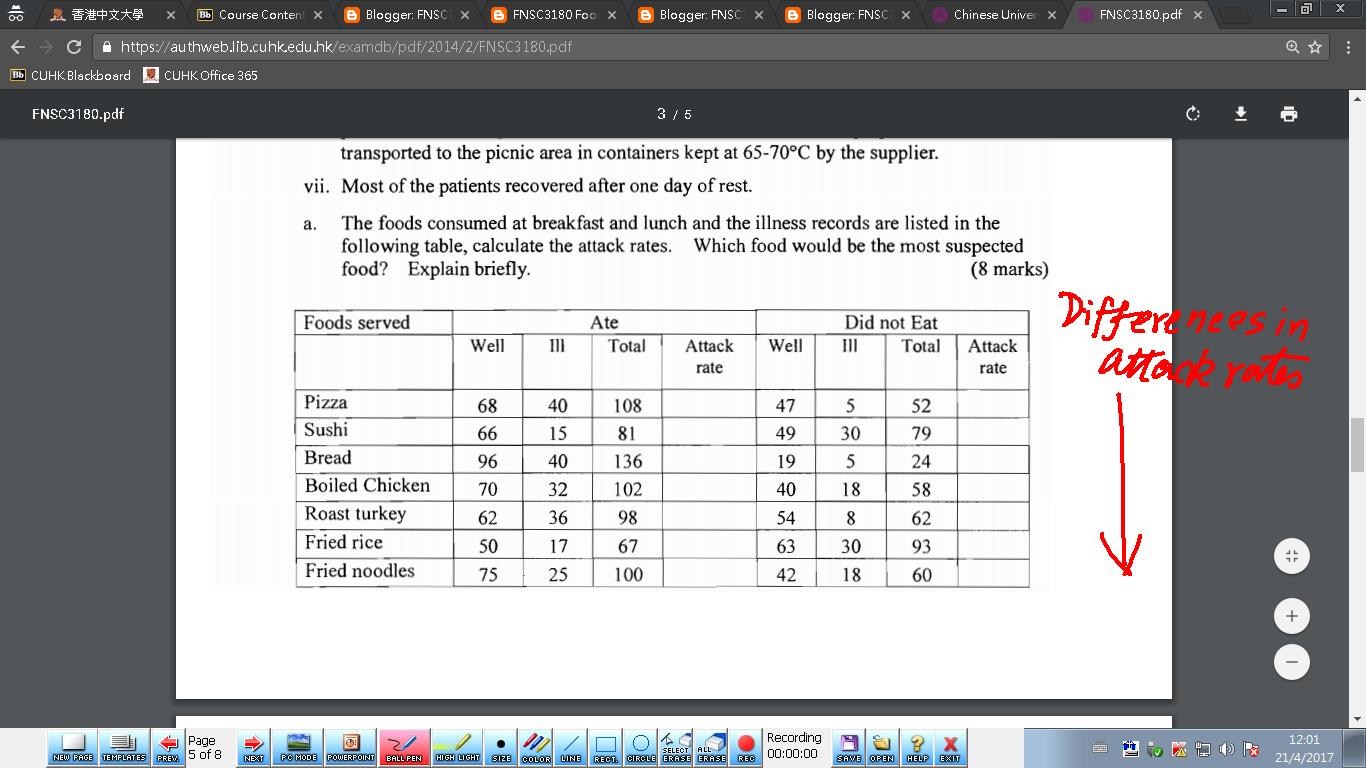
This was a mistake: The question asked about the standard process, so should use D values of the target organisms and time used in the standard process to calculate.


Monday, April 24, 2017


More notes on examination
I wish you acquire and use these skills and capabilities:
- logical
- attention to details
- organized
- thorough
- careful in calculation
- familiarize--internalize knowledge
- read questions carefully
- good time mangement
Subscribe to:
Posts (Atom)